 How-to
How to Choose a Bounce House Combo for a Party
Last Updated: November 8, 2026
Quick Summary
To choose a bounce house combo for a party, start with your guest list and age mix rather than the catalog, since head count and ages decide unit size, features, and whether you need a wet or dry setup. Match the combo's features to your youngest regular jumper, then confirm capacity and measure your setup area before booking.
- A bounce house combo pairs a jumping area with features like a slide, climbing wall, or basketball hoop.
- Ages 5-8 are the sweet spot for most combos with a slide and small climb.
- Under 10 kids need a compact combo; 20 or more kids need a larger combo or second inflatable.
- Measure usable length and width, overhead clearance, access path width, anchoring space, and blower clearance.
- Pick a dry setup for cool or unpredictable weather, pavement or gravel, and the simplest takedown.
Table of Contents
- Start With Your Guest List and Age Mix
- Use a Bounce House Size Guide to Match Party Size
- Measure Your Setup Area Before You Book
- Compare Combo Layouts and Feature Trade-Offs
- Wet vs Dry Bounce House: Which Fits Your Event?
- Your Bounce House Rental Checklist
- Book Your Bounce House Combo With Confidence
- Frequently Asked Questions
Start With Your Guest List and Age Mix
The fastest way to choose a bounce house combo for a party is to start with the guest list, not the catalog. Age mix and head count decide everything else: unit size, features, and whether you need a wet or dry setup. Two questions come before anything else: how old are the kids, and how many will jump at once?
A bounce house combo is an inflatable that pairs a jumping area with added features like a slide, climbing wall, or basketball hoop. That variety is why combos suit mixed-age parties so well. One unit keeps a 4-year-old bouncing while an 8-year-old climbs and slides.
Bounce House Age Recommendations by Group
Use these general age guidelines as a starting filter:
- Ages 3-5: low slide, shallow bounce area, heavy adult supervision
- Ages 5-8: the sweet spot for most combos with a slide and small climb
- Ages 8-12: taller slides, climbing walls, basketball hoops
- Mixed ages: pick features with two entry points so big and little kids rotate
Watch out: booking a unit built for older kids when toddlers dominate the guest list. A tall slide looks fun to parents and intimidates a 4-year-old. Match the features to the youngest regular jumper, not the oldest.
Use these general age guidelines as a starting filter when matching combo features to your youngest regular jumper.
| Age group | Recommended features | Note |
|---|---|---|
| Ages 3-5 | Low slide, shallow bounce area | Heavy adult supervision |
| Ages 5-8 | Slide and small climb | Sweet spot for most combos |
| Ages 8-12 | Taller slides, climbing walls, basketball hoops | Suits older jumpers |
| Mixed ages | Features with two entry points | Big and little kids rotate |
Use a Bounce House Size Guide to Match Party Size
A simple bounce house size guide ties unit size to how many kids jump at once, not total guests. Most combos comfortably hold a small group of jumpers at a time, so plan for rotation rather than one big crowd.
Here is a general way to think about capacity:
- Under 10 kids: a compact combo covers it
- 10-20 kids: a mid-size combo with a slide keeps lines moving
- 20+ kids: a larger combo or a second inflatable prevents bottlenecks
Always check the posted weight limit and participant capacity for the specific unit. Those numbers beat any general rule.
Guest throughput matters as much as capacity. If 20 kids each get a few minutes, stagger jump times by age group and pair the combo with a craft table or concessions so waiting kids stay busy.
Measure Your Setup Area Before You Book
Measure the setup area before you book, and measure the full clearance, not just the footprint. A combo needs flat ground, room for the blower, and safe space around the slide exit. The goal is a simple site-check worksheet you can fill in once and hand to the rental company.
The Five Numbers That Decide Fit
Write these down in feet before you call anyone:
- Usable length and width: the flat, open rectangle where the inflatable will sit, measured wall to wall or fence to fence. Do not count slopes, flower beds, or the patio step.
- Overhead clearance: the height from the ground to the lowest branch, wire, or roof line above the unit. A tall slide combo needs more vertical room than a low-profile bouncer.
- Access path width: the narrowest point between the street or driveway and the setup spot, including gates, side yards, and stair rails. The delivery crew has to move a folded inflatable and a blower through that gap.
- Anchoring space: the distance from each corner of the unit to the ground where stakes or sandbags can go. Anchoring needs open ground, not concrete or decking, unless the provider supplies a weighted alternative.
- Blower clearance: a few feet of open space at the blower end for the fan, cord, and airflow, plus a safe route for the cord back to an outlet.
A Quick Site-Check Worksheet
Sketch the yard on a clipboard and label each measurement. Then run this check:
- Mark the proposed rectangle and confirm it is flat. A slight slope is common; a steep one is a setup problem.
- Stand at the slide exit and look up. Note any branch or wire within the overhead clearance.
- Walk the delivery path from the street to the spot and measure the tightest gate or turn.
- Mark where stakes can go at each corner and confirm the ground is soft enough to hold them.
- Note the distance to walls, fences, and pools so the crew can keep a safe buffer.
- Photograph the space from two angles and attach the sketch when you reserve.
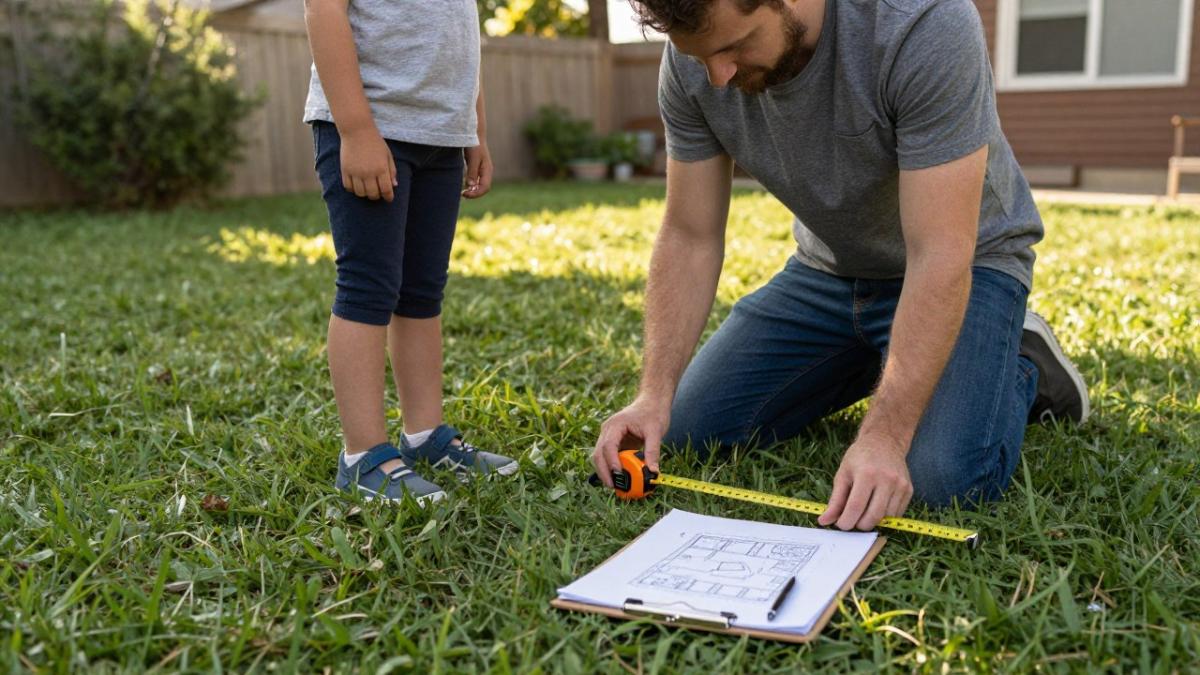
Watch out: a gate that is too narrow or a slope the crew cannot anchor on causes most setup problems. Snap a few photos of the space and share them when you reserve. It saves a headache on party day.
Compare Combo Layouts and Feature Trade-Offs
Comparing combo layouts comes down to one question: which features will your actual guests use? Every added feature trades space, setup time, or complexity for engagement.
The main combo features and what they do:
- Slide: the biggest crowd-pleaser, and the top reason families pick a combo
- Climbing wall: great for ages 6 and up, needs clear space at the base
- Basketball hoop: simple, popular with older kids, low setup fuss
- Obstacle elements: high engagement, best for bigger yards
A wet combo needs a hose connection, drainage, and a splash zone. If your yard is tight, a compact slide combo beats a sprawling obstacle layout every time.
For a closer look at which slide combo suits your kids, see which bounce house slide combo is right for your kids. And to picture real layouts before you commit, browse the photo gallery of our inflatables.
Best for: mixed-age parties with a mix of climbers and sliders. Skip if: your space is narrow or your guest list is mostly toddlers.
Wet vs Dry Bounce House: Which Fits Your Event?
A wet vs dry bounce house decision hinges on weather, space, and how much cleanup you want. Wet setups need a hose and drainage. Dry setups need neither.
Pick wet when:
- The party falls on a hot day
- You have a hose hookup and drainage
- Kids are old enough to handle a slippery slide safely
Pick dry when:
- Weather is cool or unpredictable
- Your surface is pavement or gravel
- You want the simplest setup and takedown
Wet use adds logistics and total cost: water access, a change of clothes, and slip supervision. For a deeper look at the differences, read which features matter most in a wet or dry bounce house.
Your Bounce House Rental Checklist
Run this checklist before you sign anything.
Confirm the Unit and the Site
- Confirm the unit fits your measured space and clearance
- Verify participant capacity and weight limit for your age group
- Ask for photos of the exact unit
- Confirm the anchoring plan for your surface
Check Power and Setup Requirements
- Ask what power the blower needs and whether a standard outdoor outlet is enough
- Confirm whether the cord and any adapter are included
- Note the setup and takedown windows and who is responsible for each
- Confirm the delivery path matches the gate and access width you measured
Review the Agreement Terms
- Ask how the inflatable is cleaned between rentals
- Review the weather and cancellation policy in writing
- Confirm what happens if something goes wrong on party day
- Ask about insurance and who covers damage or injury
- Confirm any cleaning or water-use terms if you are considering wet use
Coordinate the Rest of the Party
- Ask whether tables, canopies, and concessions arrive in the same delivery
- Confirm the drop-off and pickup times line up with your event schedule
That last point saves real time. Coordinating one provider for the combo, tables, and a canopy beats juggling three companies. For a printable version, use our pre-booking bounce house rental checklist.
Book Your Bounce House Combo With Confidence
Booking early is a good move, since popular dates can fill up. Reserve once your date and space are confirmed.
A few habits make booking smooth:
- Share photos of your setup space
- Note gate width and surface type
- Book last-minute only after checking live availability
- Ask for real photos of the exact unit
Our online booking makes reserving simple, and we offer tables, chairs, canopies, and concessions alongside our inflatables. To compare options and reserve, see how to compare bounce house combo rental prices.
Ready to lock in your date? Start with our online booking, confirm your space, and let us handle delivery and setup so you can enjoy the party.
Frequently Asked Questions
What is a bounce house combo?
A bounce house combo pairs a standard jumping area with at least one extra feature, such as a slide, climbing wall, or basketball hoop. That added variety keeps kids engaged longer and suits a wider age range than a plain bouncer. When you choose a bounce house combo, check the listed participant capacity and weight limit, since combo units vary in size and how many children can safely use them at once.
How much space do I need for a bounce house combo?
Space needs depend on the unit, so ask the rental company for the exact length, width, and height of the combo you want. Measure your setup area and add clearance around all sides for safe entry, exit, and anchoring. Also check for overhead branches, power lines, and fence lines. A flat, clear surface works best, and the company should confirm the required footprint before your booking is finalized.
Should I choose a wet or dry bounce house combo?
Pick a wet combo when the event centers on water play and you have a drain-friendly surface plus warm weather. Choose dry for backyard parties, indoor events, or mixed-age groups where slipping is a concern. A wet vs dry bounce house decision also affects setup time, drying, and cleanup, so confirm the rental terms for each option and keep a dry backup plan in case of weather changes.
What should I check before booking a bounce house combo?
Run through a bounce house rental checklist: confirm the unit size fits your space, verify age and weight limits, ask about sanitizing between rentals, and review delivery, setup, and pickup windows. Check the rental agreement for weather and cancellation policies, confirm whether an attendant is included, and make sure the reservation is confirmed in writing before the party date.