 blog
7 Things to Check Before Renting a Bounce House Combo
Last Updated: October 23, 2026
Quick Summary
The 7 things to check before renting a bounce house combo are safety documentation and insurance, cleaning and maintenance between rentals, combo-specific layout and fall hazards, anchoring and ground stability, supervision requirements and rules, setup space and electrical needs, and total cost with contract details. Verify each in writing before you book to avoid safety risks and party-day surprises.
- Request a current certificate of insurance, inspection records, and written safety guidelines from the rental company before signing.
- Confirm the combo fits your yard by measuring total length, width, height, overhead clearance, slide run-out distance, and access path.
- Ask for the wind cutoff speed, rain policy, lightning rule, and refund or reschedule terms in writing before you pay.
- Verify the recommended age range, maximum weight limit per child, and total capacity match your guest list.
- Get an itemized quote covering base rental, delivery, setup, pickup, cleaning, damage deposit, and all add-ons before committing.
Table of Contents
- Questions to Ask Before Renting a Bounce House
- Bounce House Rental Safety Standards
- Bounce House Setup Requirements and Space Planning
- Verify Age Range, Capacity, and Weight Limits
- Bounce House Cleaning Standards and Maintenance
- Review Delivery, Setup, and Cancellation Policies
- Confirm Total Rental Cost and Contract Details
- Frequently Asked Questions
Questions to Ask Before Renting a Bounce House
Before you book a bounce house combo, here are 7 things to check before renting a bounce house combo to ask the right questions. What you verify upfront separates a great rental from a stressful one.
Safety Documentation and Insurance
Ask for written proof the inflatable meets industry safety standards and that the company carries liability insurance. Request a certificate of compliance or inspection reports, proof of liability coverage, written safety guidelines, and anchoring details. If something goes wrong and the company has no insurance, you could be liable. A reputable provider will have these ready immediately.
Cleaning and Maintenance Between Rentals
How does the company clean between events? A dirty or damp bounce house creates health risks for your kids. Ask what cleaning process they use after each rental, whether they sanitize high-touch areas like handholds and slides, how they dry the equipment, and what happens if it gets wet or muddy during your event. A quality provider will name specific products, drying methods, and inspection procedures.
Bounce House Rental Safety Standards
"We follow all safety standards" is not an answer you can act on. Get the standards in writing and understand how they apply to the specific unit, layout, and ground. A combo is a jump area plus a slide, climbing wall, obstacle run, or splash feature, each adds its own entry, exit, and fall-height considerations.
Written Safety and Insurance Documentation Checklist
Ask for a documentation packet before you sign, and note what is missing:
- Certificate of insurance (COI) naming the rental company and showing general liability coverage that is current for your event date. Ask whether the policy covers inflatable amusement devices specifically, not just general business liability.
- Inspection or compliance record for the unit, the date of the last inspection, who performed it, and what was checked (seams, blower, anchor points, slide rails, netting, entry/exit step).
- Manufacturer or industry standard reference the unit is built to. Inflatables in the U.S. are commonly referenced against ASTM F2374 and state or local amusement-device rules. Ask the company to name the standard they build and inspect to rather than accepting "industry standard."
Combo-Specific Layout and Fall-Hazard Checks
Layout is where most avoidable combo injuries happen. Walk the unit (or review photos) and confirm:
- Entry and exit design. Is there a single controlled entry with a step or ramp? A combo with a slide typically needs a separate, gated slide exit so kids do not land in the jump traffic lane.
- Slide run-out and landing zone. Ask how much clear space the slide needs at the bottom and whether the landing is padded. Confirm the slide height suits your youngest guest, not just the oldest.
- Climbing wall and obstacle sections. Check handholds, netting height, and whether the climb empties into the jump floor or a wall. A climb that dumps kids into active jumpers is a collision risk.
Anchoring, Stability, and Ground-Surface Verification
A combo is taller and heavier than a simple bounce house, so wind load and anchor demands are higher. Ask how many anchor points this specific combo has and where they sit relative to the slide and climb sections; whether they use stakes, sandbags, or both for your surface; whether they will inspect the ground and refuse a location that won't hold anchors; their wind-speed cutoff for setup and operation; and the shutdown procedure if wind picks up mid-event.
Supervision Requirements and Rules
Every combo should come with clear, written rules. Ask for them and confirm they match the unit: maximum children at once and total weight on the jump floor; recommended age range for the combo and each feature; whether an adult attendant must be present continuously and the recommended adult-to-child ratio; height and weight restrictions per child; prohibited activities (flips, roughhousing, food or drinks inside, shoes, glasses, objects in pockets); and the injury procedure and who documents an incident.
Bounce House Setup Requirements and Space Planning
Your yard has to meet the unit's requirements, not the other way around. Most rentals go sideways at setup, space too tight, outlet too far, or ground that won't hold stakes. Verify these before you book.
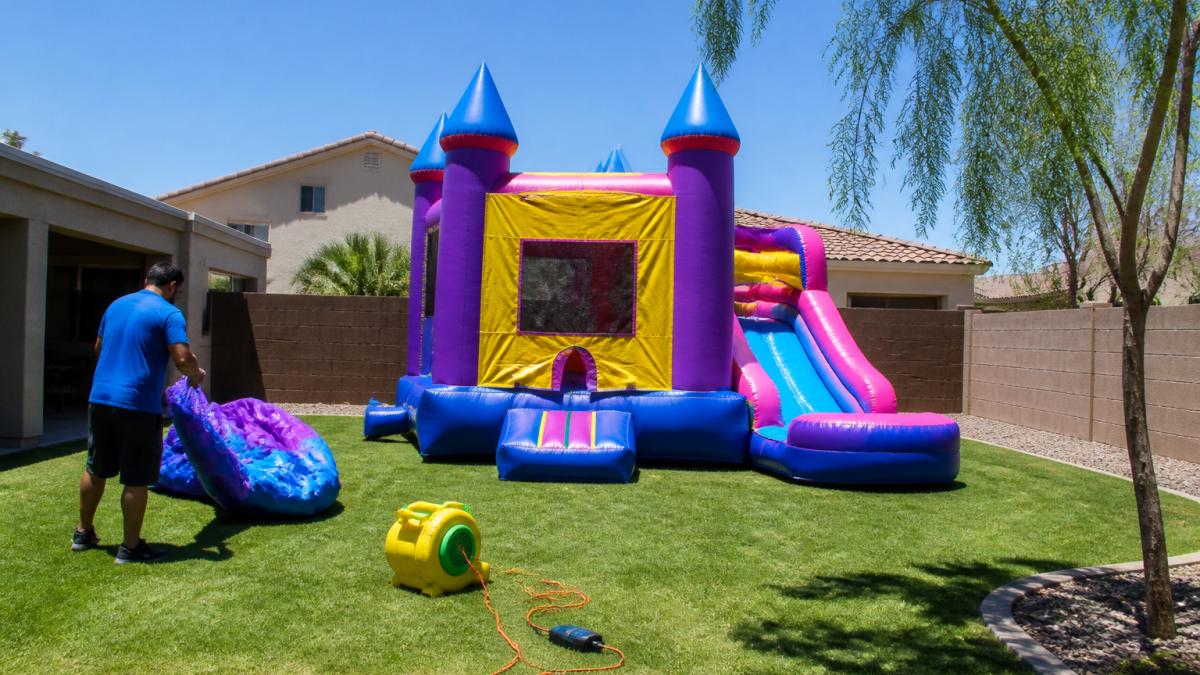
Measuring Space for a Combo, Not a Simple Bounce House
A combo needs more footprint and clear height than a plain bounce house. Get the exact length, width, and height for the specific unit and measure your space against them:
- Total length and width of the flat area you can dedicate to the unit.
- Clearance on all sides. Plan for at least 3 feet around the unit for entry, exit, and blower access; more on the slide run-out side.
- Overhead clearance to branches, roof overhangs, wires, and garage doors. A combo is taller than a standard bounce house, so measure height, not just ground area.
Power and Electrical Requirements
Every combo runs on a blower that needs a dedicated, reliable circuit. Confirm these details in writing:
- Outlet distance. Measure from the blower position to the nearest outlet. Ask the maximum cord length they allow and whether they supply the cord.
- Cord rules. Ask whether they require a GFCI-protected outlet, an outdoor-rated cord, and a cord gauge appropriate to the run length. A long run on a thin cord causes voltage drop and blower overheating.
- Circuit load. Ask the blower's amperage draw and whether it needs a dedicated circuit. Sharing with a refrigerator, space heater, or kitchen appliances can trip the breaker mid-party.
Ground Surface, Slope, and Anchoring Compatibility
Surface type determines the anchoring method and whether setup is safe at all. Ask which surfaces the company sets up on and which they refuse:
- Grass, holds stakes well when firm and dry; soft, saturated, or frozen ground will not hold.
- Concrete, asphalt, artificial turf, stakes will not work; sandbags or weighted anchors are required. Confirm the company brings them.
- Slope, ask the maximum slope they will set up on and how they compensate. A pitched surface shifts load and can make the slide exit unsafe.
Weather Decision Process and Cancellation Terms
Weather is the most common reason a combo rental gets cancelled or cut short. Get the decision rules in writing. Ask:
- Wind cutoff. What sustained or gust wind speed triggers a no-setup or shutdown? Confirm the number and who makes the call.
- Rain policy. Will they set up in light rain? What about a wet surface or standing water? Ask whether the unit can be used wet and how it must be dried.
- Lightning and heat. Confirm the lightning rule (typically any thunder or lightning means shutdown) and whether heat changes supervision or hydration guidance.
Verify Age Range, Capacity, and Weight Limits
Every combo is designed for specific age ranges and weight limits. Using it outside those parameters creates safety risks. Ask the rental company: the recommended age range for this specific combo; the maximum weight limit per child; the maximum total capacity; whether there are separate areas for different age groups; and whether the combo works for a mix of 4-year-olds and 8-year-olds or should be used separately.
Bounce House Cleaning Standards and Maintenance
Before finalizing your booking, understand how the company maintains cleanliness and addresses damage. Ask directly: how is the inflatable cleaned before it arrives; what cleaning supplies do they use (are they safe for children); if it gets visibly dirty during your event, will they address it; what happens if guests damage it (small tears, punctures); whether you are responsible for accidental damage or their insurance covers it; and how quickly they can repair damage.
Review Delivery, Setup, and Cancellation Policies
Logistics matter as much as the equipment. A late delivery or poor setup ruins your party timing.
On-Time Delivery and Professional Setup
Ask these specific questions about delivery and setup:
- What's your delivery window (exact time or time range)?
- Will the company call 30 minutes before arrival?
- How long does setup typically take?
Professional setup includes testing the blower, checking seams and anchor points, and walking you through safety rules.
Weather Cancellation and Refund Terms
Weather can force a cancellation or reschedule. Know the policy before you book. Ask what weather conditions trigger a cancellation (rain, wind speed, lightning); whether you get a full refund or reschedule credit if you cancel due to weather; your recourse if the company cancels; how much notice they need; and whether you can postpone to another date or it's refund-only.
Confirm Total Rental Cost and Contract Details
Price matters, but total cost is what counts. Ask for a complete breakdown before you commit. Request an itemized quote covering the base rental fee, delivery and setup fees, pickup fees, cleaning fees (if any), damage deposit or security fee, any add-ons (tables, chairs, canopy, concessions), total cost and payment schedule, and cancellation fees. Ask for everything upfront to avoid hidden fees.
Planning a bounce house combo rental doesn't have to be stressful, follow 7 things to check before renting a bounce house combo and you'll have what you need to decide confidently. Ask these seven questions before you book and you'll have what you need to decide confidently. At Lil Bubs Bounce House, transparency and safety are key. We offer detailed cleaning protocols and professional setup every time. When you're ready to book, visit our website for a quote and real photos of our equipment.
Frequently Asked Questions
What should I ask before renting a bounce house combo?
Ask about cleaning protocols between rentals, safety certifications, anchoring methods, power requirements, delivery and setup times, age and weight restrictions for your children, weather cancellation policies, and the total rental cost including any deposits or additional fees. Request photos of the actual inflatable you'll receive and confirm the company's liability insurance coverage. These questions help ensure your bounce house combo rental is safe, properly maintained, and meets your event needs.
How do I know if a bounce house rental is clean and safe?
Request details about the cleaning and sanitization process used between rentals. Ask if the equipment is inspected for tears, seams, and structural damage before delivery. Verify that the rental company has liability insurance and follows industry safety guidelines. Request references or customer reviews mentioning cleanliness and condition. Ask to see photos of the specific bounce house combo you'll receive, not just generic images. Reputable providers will openly share their maintenance standards and inspection procedures.
How much space do I need for a bounce house combo?
Bounce house combos typically require 15 to 20 feet of length and 12 to 16 feet of width, depending on the specific model. You'll also need 8 to 10 feet of overhead clearance above the inflatable. Measure your setup location carefully and confirm dimensions with the rental company before booking. Check for obstacles like tree branches, power lines, fences, and structures that could interfere with setup or create safety hazards. Provide the rental company with accurate measurements so they can confirm the combo will fit your space.
Do bounce houses need to be plugged in?
Yes, bounce house combos require continuous power to operate the air blower that keeps the inflatable inflated. Most rentals need access to a standard 110-volt electrical outlet within 50 to 100 feet of the setup location. If you don't have an outdoor outlet, ask the rental company if they can provide a generator for an additional fee. Confirm power availability before booking to avoid setup delays or cancellations on the day of your event.