 blog
Which Bounce House Slide Combo Is Right for Your Kids?
Last Updated: October 26, 2026
Quick Summary
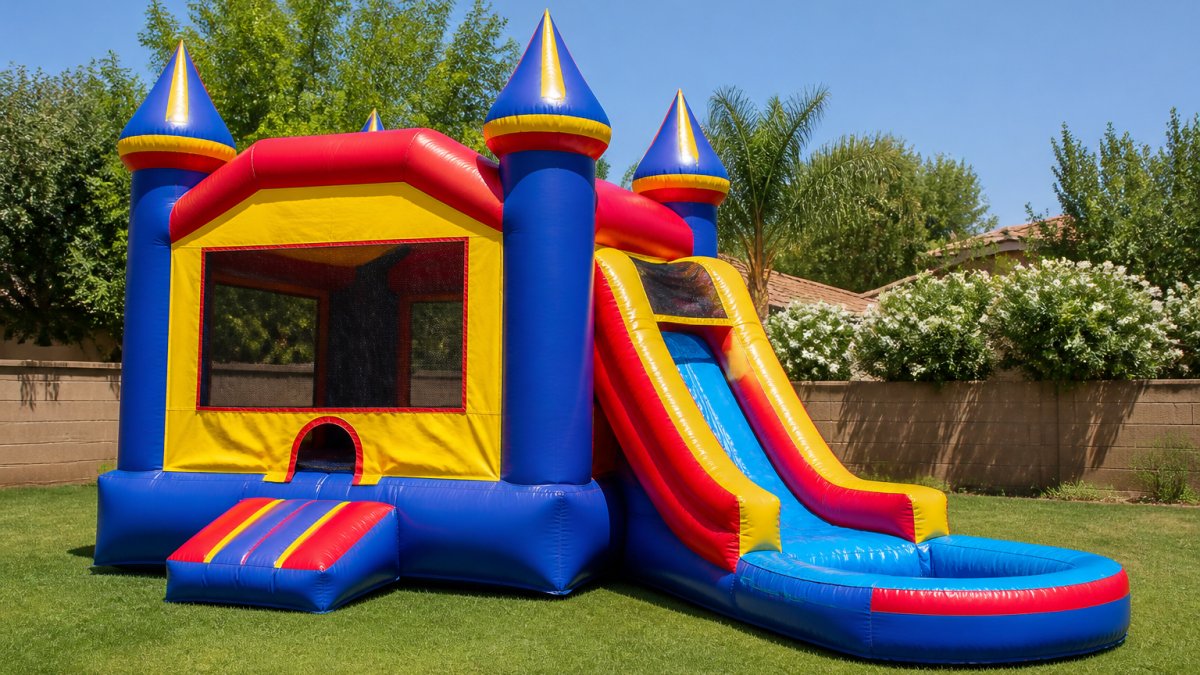
A bounce house slide combo combines bouncing, sliding, and climbing in one inflatable, solving the entertainment problem for kids' parties by keeping them engaged for 2-3 hours through rotating activities. The right bounce house slide combo matches your kids' ages, your available space, and whether you want water play features.
- Toddlers ages 2-4 need low bounce surfaces and gentle slides, while kids ages 5-8 can handle taller slides, climbing challenges, and water play.
- A typical single-lane combo needs about 19 ft x 24 ft total space including clearance, while dual-lane combos need about 22 ft x 28 ft.
- Wet combos extend engagement on hot days but require drainage planning, while dry combos offer year-round flexibility without water cleanup.
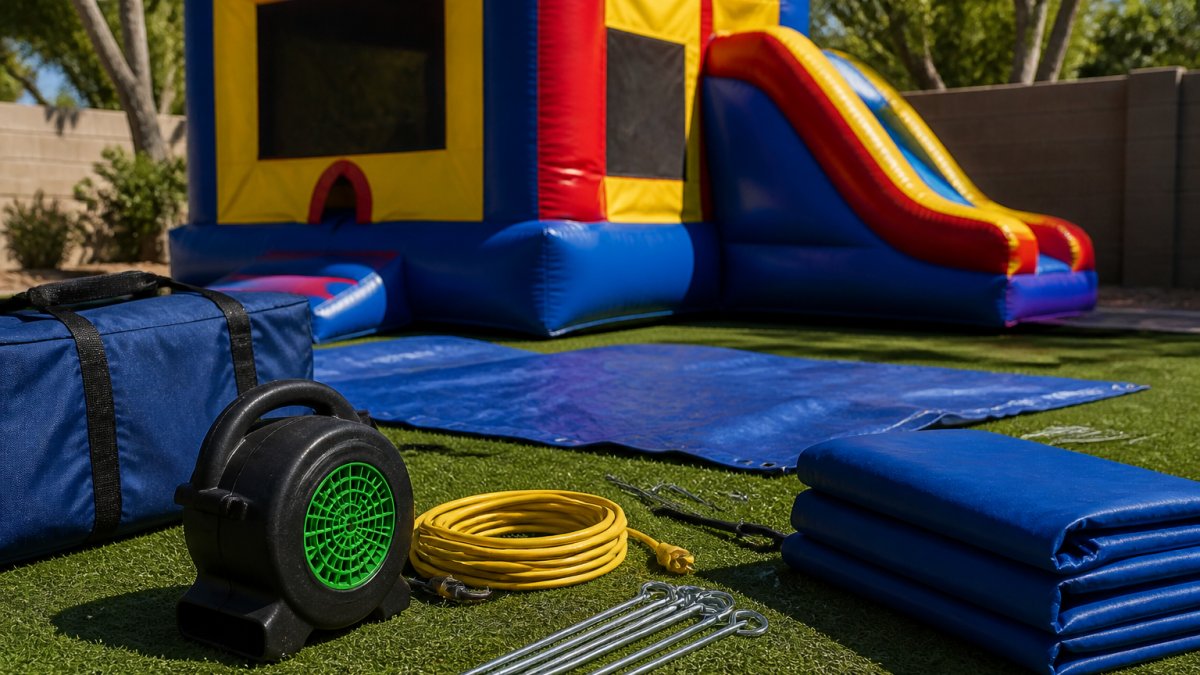
- Anchoring per manufacturer instructions is essential for safety, with stakes for grass or dirt and sandbags for concrete or asphalt.
- Supervision by a designated adult with an unobstructed view of the entire unit is the single most important safety factor.
Table of Contents
- What Makes a Great Bounce House Slide Combo
- Bounce House Water Slide Combo Options: Wet, Dry, and Hybrid Models
- Best Bounce Houses for Toddlers and Kids: Age and Size Matching
- Bounce House Size and Space Requirements: Planning Your Setup
- Bounce House Safety Features Every Parent Should Know
- Durability, Maintenance, and Long-Term Value
- Book Your Perfect Inflatable Combo Today
- Frequently Asked Questions
What Makes a Great Bounce House Slide Combo
A great bounce house slide combo combines safety, age-appropriate features, and play variety in one inflatable, so kids can bounce, slide, and climb without renting separate pieces.
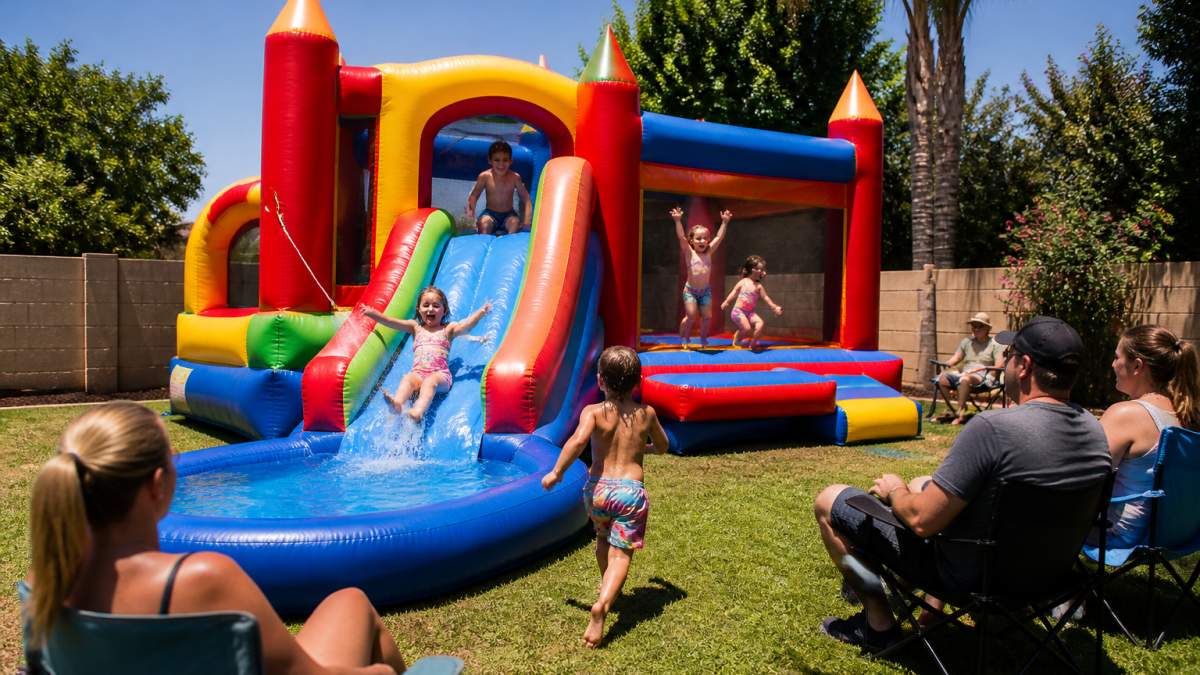
What separates a solid combo from one that sits unused is how well it matches your kids' ages and space. A toddler-sized combo plays differently than a dual-lane slide with a climbing wall for older kids.
Whether to rent a simple bounce house or a combo depends on three factors: how many kids are coming, their ages, and whether you want water play. A bounce house slide combo solves the "what do we do for the full party" problem because kids rotate between bouncing, sliding, and climbing for 2-3 hours.
Bounce House Water Slide Combo Options: Wet, Dry, and Hybrid Models
Your choice between wet, dry, and hybrid bounce house water slide combo options shapes the entire party experience.
A dry-only combo gives year-round flexibility: no swimsuits, no water cleanup, works in any season, but misses a major source of entertainment on hot days.
For most warm-month backyard parties, a wet combo delivers the best value: kids get bored bouncing alone after an hour, and water extends engagement.
Best Bounce Houses for Toddlers and Kids: Age and Size Matching
The biggest mistake parents make is renting a combo designed for 8-year-olds when most guests are 4.
For toddlers (ages 2-4), look for low bounce surfaces, gentle slides, and soft climbing elements.
For kids ages 5-8, combos can be more ambitious: taller slides, more climbing challenges, and often water play.
Capacity matters too.
Children's Hospital of Orange County Health research on inflatable safety notes that injuries increase when equipment doesn't match the user's age and size.
Bounce House Size and Space Requirements: Planning Your Setup
Before you book, measure your yard. A bounce house slide combo needs more space than most parents expect, and undersizing creates safety issues, limits players, and can void a rental agreement.
Start with the inflatable footprint, then add clearance
Every combo has two numbers that matter: the inflated footprint and the required clearance. A common pattern is at least 3 feet of clear buffer on every side, and more at the slide exit and entrance, so kids can land, line up, and step in without colliding with fences, trees, or patio furniture.
| Combo type | Typical inflated footprint | Typical clearance per side | Typical total space needed |
|---|---|---|---|
| Toddler combo with short slide | About 10 ft x 12 ft | 3 ft | About 16 ft x 18 ft |
| Single-lane combo with slide | About 13 ft x 18 ft | 3 ft | About 19 ft x 24 ft |
| Dual-lane combo with slide | About 15 ft x 20 ft | 3-4 ft | About 22 ft x 28 ft |
| Combo with climbing wall and splash zone | About 15 ft x 22 ft | 4 ft | About 23 ft x 30 ft |
These are planning ranges, not guarantees. A unit listed at 13 ft x 18 ft inflated can still need a 20 ft x 25 ft site once you account for the blower tube, entrance ramp, and slide run-out. Always ask for the manufacturer's dimensions and clearance before you commit.
The fit-check method that prevents party-day surprises
Use this sequence before you book:
- Measure the flat, level area, not the whole yard. Slopes, roots, and sprinkler heads shrink usable space.
- Subtract the clearance from your measured area on all four sides. What's left is your usable footprint.
- Compare usable footprint to the unit's inflated dimensions. If the unit is larger, it doesn't fit safely, even if it physically inflates.
- Check the path to the site. A combo needs a clear route at least as wide as the rolled unit, typically 3-4 feet, with no sharp turns, low branches, or narrow gates.
- Confirm overhead clearance. Look for branches, power lines, and roof overhangs; most operators want at least 15 feet of vertical clearance above the unit.
Ground, slope, and surface rules
Grass is the most common and forgiving surface. Dirt works if firm and free of rocks. Concrete and asphalt are acceptable when level but harder on joints and require anchoring per the manufacturer's instructions. Avoid:
- Slopes steeper than about 5 degrees, which can shift the load and stress anchors
- Areas with sprinkler heads, stumps, or buried utilities
- Gravel, mulch, or sand that won't hold stakes securely
Power and blower placement
Most combo blowers draw roughly 6-12 amps on a standard 120-volt circuit, and many manufacturers recommend a dedicated circuit. Plan for a grounded outlet within about 50 feet of the blower; beyond that you'll need a rated outdoor extension cord, which adds a trip hazard. Keep the blower dry and elevated, and route the cord away from foot traffic.
Water combos need drainage planning
A wet combo sends water onto the ground beneath and around the unit, so identify where it will go. A slight slope away from the party area is ideal; if your yard is flat or drains toward the house, plan a tarp or shallow containment area and expect mud at the slide exit. Confirm whether the unit recirculates water or runs from a hose, since that changes water use and setup time.
Setup time and access
Most combos take 30-45 minutes to position, inflate, anchor, and test, and wet combos take longer due to the water hookup and splash-zone placement. Describe your yard, gate width, surface, and outlet location when you book so the crew arrives with the right anchors, cords, and hose length. We handle delivery and setup, so you don't have to figure out these logistics alone.
Bounce House Safety Features Every Parent Should Know
Safety isn't a feature you add; it's built into every aspect of a quality combo and reinforced by rules the operator and supervising adult follow.
Anchoring is the first safety feature
Every inflatable must be anchored per the manufacturer's instructions, and the method must match the surface:
- Grass or dirt: steel stakes driven at an angle, one at each anchor point, with the strap or rope taut
- Concrete or asphalt: sandbags or weighted anchor bags at each point, since stakes can't be driven
- Never rely on the blower's weight or on furniture to hold a unit down
Ask the rental company how many anchor points the unit has and what they use for your surface. A unit that isn't fully anchored can lift or shift in a gust, one of the most serious failure modes for any inflatable.
Blower and air-chamber design
A quality blower has a thermal overload shutoff and should be plugged into a grounded outlet with adequate circuit capacity. Many combos use multiple air chambers so a single puncture doesn't deflate the whole unit. Confirm both features before you book, and keep the blower running the entire time, since most combos are constant-air inflatables.
Slide design and entry/exit
The slide surface should have texture or grip so kids don't slide too fast, and the angle should let a child control their descent and land on a clear run-out. Entry and exit points need sturdy steps, handholds, and netting or barriers that prevent falls from height. Keep the slide exit clear of fences, toys, and hard surfaces, and have kids exit to the side rather than into the next slider's path.
Weight, user count, and age limits are real limits
Every combo has a maximum user weight, a maximum number of simultaneous users, and a recommended age range. These aren't suggestions: exceeding them stresses seams, increases fall risk, and can void the rental agreement. A common pattern is 6-8 simultaneous users of similar size; mixing a 12-year-old with a 3-year-old is a size-mismatch risk even within the count.
Supervision: the single most important factor
A supervising adult should have an unobstructed view of the entire inflatable, including the slide exit and entrance, and be close enough to intervene. Common guidance is to designate one adult as spotter, keep the user count within limits, remove shoes, glasses, and loose jewelry, and stop play if kids wrestle, flip, or climb the netting. Rough play is the most common path from a safe unit to an injury.
Weather and site restrictions
Most operators won't set up in high wind, and many have a wind-speed cutoff in their rental agreement. Rain makes surfaces slick and can damage the blower if water reaches electrical components. Heat matters too: vinyl in direct summer sun gets uncomfortably hot, so plan shade or a water feature and keep kids hydrated.
Cleaning and inspection before every use
Ask the rental company how they clean and sanitize between rentals, and look for a unit that arrives dry and visibly inspected. A quick pre-use walk-around should check anchors, seams, the blower connection, the slide surface, and the netting.
Consumer Product Safety Commission guidance on inflatable amusement attractions publishes safety information for inflatable rides and attractions that is worth reviewing before any party. Before your event, learn what to check before renting to ensure safety and quality by reviewing our detailed guide.
Durability, Maintenance, and Long-Term Value
A cheap combo that needs replacement after two seasons costs more than a quality one that lasts five years.
Commercial-grade combos use thicker vinyl, reinforced seams, and higher-quality blowers. They cost more upfront but hold up to repeated use.
Maintenance between rentals matters enormously.
The blower is the most common failure point: a quality blower lasts 5+ years, while a cheap one might fail after 50 uses.
Storage also affects lifespan.
Industry guidance on inflatable maintenance standards recommends regular inspection for wear, proper cleaning protocols, and prompt repair of small issues before they become major problems.
When comparing rental options, the cheapest option upfront often costs more because you're dealing with equipment that breaks down, gets replaced mid-party, or requires multiple rentals because one combo isn't reliable. Learn how to compare bounce house combo rental prices to make a cost-effective choice.
Book Your Perfect Inflatable Combo Today
Choosing the right bounce house slide combo means matching the equipment to your kids' ages, your space, and the play experience you want.
We handle logistics, delivery, setup, sanitization, and breakdown, so you focus on the celebration.
Tell us your kids' ages, your yard size, and what kind of party you're planning. We'll recommend the perfect combo and handle everything from there.
Frequently Asked Questions
What is the best bounce house with water slide combo for a 6-year-old's birthday party?
The best bounce house slide combo for a 6-year-old depends on your backyard space and party size. Look for a wet/dry combo with a single-lane slide, jumping area, and splash pad. Ensure the weight capacity accommodates your guest count, and verify the inflatable fits your available yard space, most combos need 15×15 feet minimum. Check that the slide height and climbing wall suit children aged 4-8 without being too advanced or too babyish.
How much space do you need for a bounce house with a slide?
Bounce house slide combos typically require 15×15 feet to 20×20 feet of flat, clear yard space, depending on the model. Measure your available area and account for setup clearance around all sides. Combo units with water features may need additional space for the splash pad or kiddie pool. Always leave extra room for adult supervision and guest movement around the inflatable.
Are bounce house water slide combos suitable for toddlers?
Some bounce house water slide combos work for toddlers, but many are designed for kids aged 4 and up. Look for models with lower slide heights, gentler climbing walls, and separate toddler-friendly play areas like ball pits or shorter jumping zones. Always check the manufacturer's age and weight guidelines, and provide constant adult supervision. Avoid high-speed water slides for very young children; dry bounce areas are often safer for toddlers.
What safety features should a kids' bounce house combo have?
Essential safety features include reinforced seams, adequate padding on hard surfaces, secure netting or walls to prevent falls, non-slip surfaces on slides and climbing areas, and proper weight capacity labeling. Ensure the blower is reliable and the inflatable stays fully inflated during use. Look for commercial-grade materials and check that setup includes secure anchoring. Always verify the equipment is cleaned and inspected before each rental to reduce injury risk.
The difference between a forgettable party and one kids talk about for months often comes down to having the right entertainment. A quality bounce house slide combo does that work. Let us help you get it right.