 ultimate-guide
Bounce House Safety Checklist for Parents
Last Updated: October 30, 2026
Quick Summary
Bounce house safety depends on the setup, the guests and the weather. Check the ground, clearance and power before delivery, anchor every point, and confirm the unit is firm and fully inflated before the first jump. Keep to the manufacturer's age, weight and capacity limits, and shut the unit down when winds pick up or lightning threatens.
- Choose flat, level ground free of rocks, roots and sprinkler heads.
- Anchor every point with stakes or approved weights and keep the straps taut.
- Group children by size, and count jumpers against the rated capacity.
- Shut the unit down as soon as winds pick up or lightning threatens.
- Assign an adult supervisor who watches the unit and enforces the rules.
Table of Contents
- Why a Bounce House Safety Checklist Matters for Parents
- Bounce House Setup Checklist: Site, Anchoring and Inflation
- Bounce House Safety Rules Every Guest Should Follow
- Bounce House Age and Size Limits by Group
- Bounce House Weather Safety: When to Shut It Down
- Supervision, Breaks and What to Do in an Emergency
- Booking Your Party Rental With Lil Bubs Bounce House
- Frequently Asked Questions
Bounce houses are one of the most popular features at a children's birthday party, and they carry real risks when they are set up or supervised poorly. A bounce house safety checklist for parents gives you a repeatable way to check the setup, the guests and the weather before anyone takes a jump. Lil Bubs Bounce House has put together this guide to the checks that matter most.
Why a Bounce House Safety Checklist Matters for Parents
A bounce house is an inflated structure that children jump on, bounce against and climb over, often with more kids than the unit was designed to hold. Most parties go smoothly, and bounce houses are generally considered safe for most children when used as intended (Constant Air Inflatable Play Devices).
A checklist turns those details into a short routine you can run before, during and after the party. Work through it at delivery, again before the first jump, and whenever the weather changes.
Bounce House Setup Checklist: Site, Anchoring and Inflation
Setup is where many problems start, so check the site before the unit goes down, and check the unit itself before you accept delivery. A pre-rental and delivery inspection is a useful step to catch problems before children ever line up.
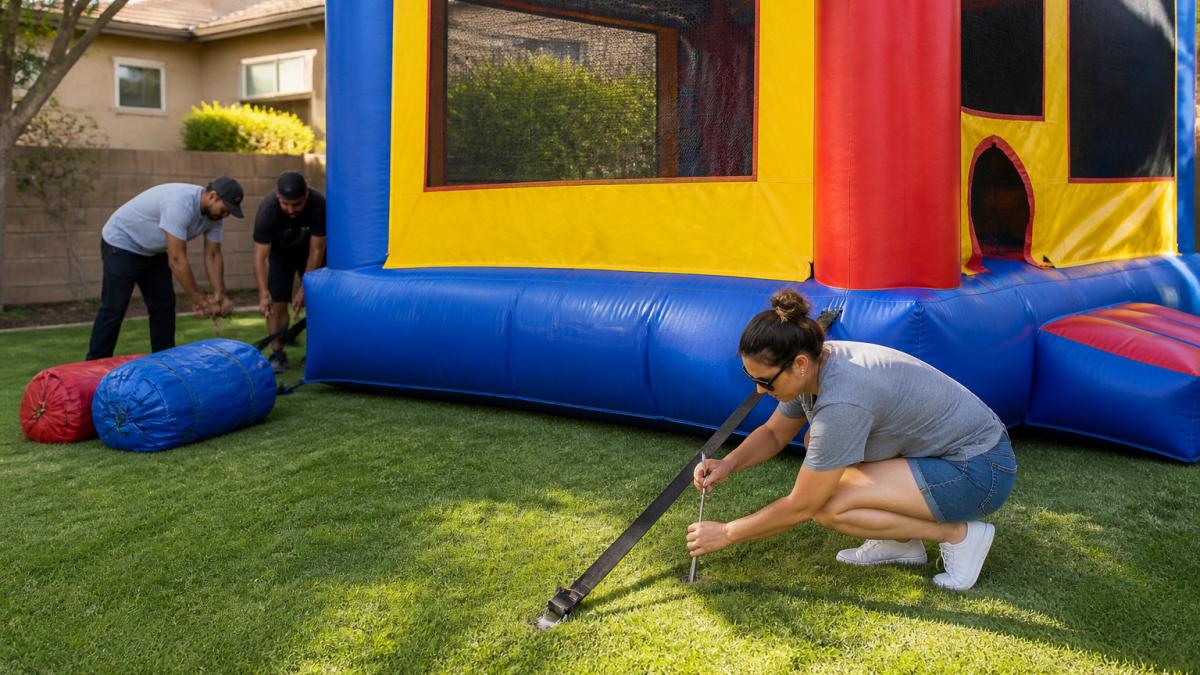
Before the rental: verify the equipment and the operator
- Ask what the unit is rated for. Confirm the manufacturer's age, weight and maximum-jumper limits, and make sure the unit you are booking matches the ages at your party.
- Ask how the unit is anchored. A legitimate operator should be able to tell you whether they use stakes, sandbags or both, and how many anchor points the unit has.
- Ask about inspection and insurance. Ask whether the unit is inspected and whether the operator carries liability insurance.
At delivery: inspect before you sign
Walk the unit with the delivery person before they leave. Look for tears, loose or frayed seams, damaged netting, exposed blower cords and a blower that runs without tripping a breaker. Confirm the anchor points, straps and stakes or weights are all present and in good condition. Ask the operator to demonstrate the blower switch and show you how to shut the unit down quickly.
Site selection: ground, clearance and power
- Choose flat, level ground. A slope shifts weight to one side and makes the unit less stable. Look for an area free of rocks, sprinkler heads, tree roots and dips.
- Leave clearance around the unit. Keep the bounce house away from fences, walls, grills, pools and other structures, and check that guests can reach the entrance without crossing a hazard. Leave room overhead for branches and power lines.
- Plan for power. The blower needs a grounded outlet or a properly rated extension cord kept out of walkways and away from water. Do not run cords across a path guests will use.
Anchoring and inflation
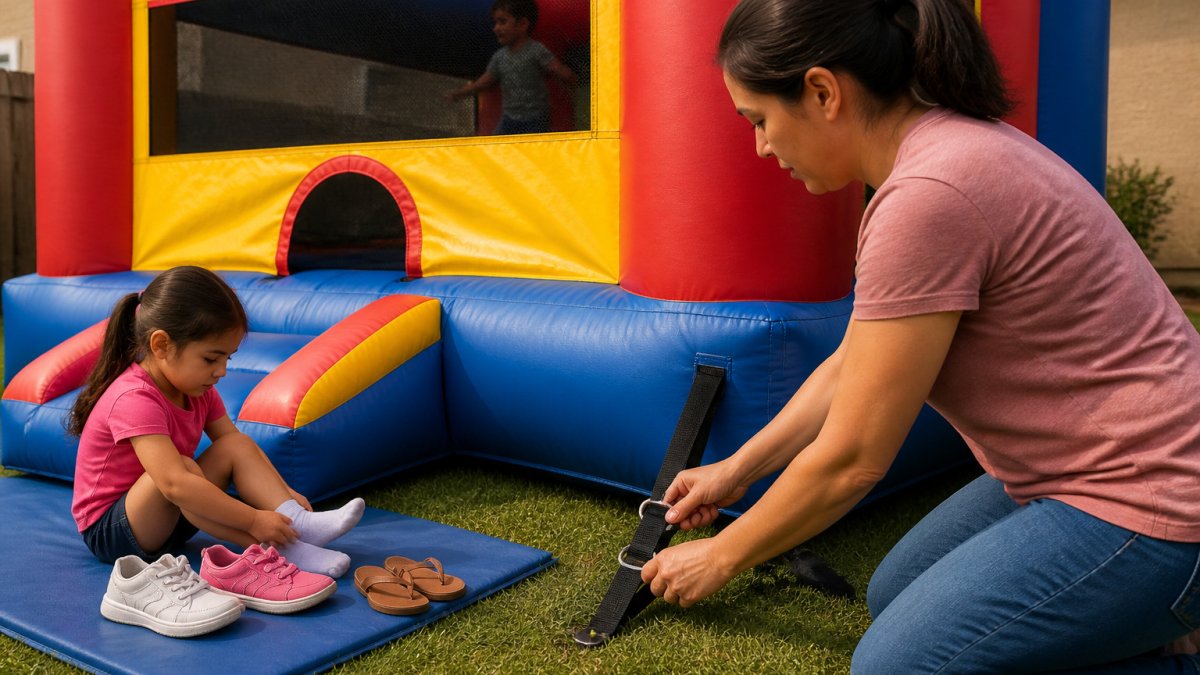
- Anchor every point. Secure each anchor point with stakes or approved weights, and confirm the straps are taut. A unit that lifts or shifts in the wind is not anchored properly.
- Confirm it is fully inflated. Walls should be firm and upright, with no sagging sections. An underinflated unit is less stable and gives less cushioning when children land.
Before the first guest enters, walk the inside and outside of the unit once more. Look for tears, loose seams, exposed blower cords and anything left on the floor.
The table below sums up the main setup checks so you can run through them quickly at delivery and before the first jump.
| Check | What to look for | When |
|---|---|---|
| Ground | Flat, level, free of rocks, roots and dips | Before delivery |
| Clearance | Away from fences, grills, pools and power lines | Before delivery |
| Power | Grounded outlet or rated cord out of walkways | Before inflation |
| Anchor points | Stakes or approved weights on every point, straps taut | Before first jump |
| Inflation | Walls firm and upright, no sagging sections | Before first jump |
| Blower switch | Operator shows how to shut the unit down | At delivery |
| Surface | Dry, not pooling water | Before inflation |
Bounce House Safety Rules Every Guest Should Follow
Rules only work if guests hear them before they start jumping. Post them near the entrance and repeat them at the start of the party.
- Take off shoes and remove jewelry. Shoes can scuff or tear the material, and jewelry, hair clips and necklaces can catch on netting or snag another child.
- Leave sharp objects and food outside. Keep toys, drinks, food and sharp objects out of the unit, since they can cause cuts or choking.
- Enter and exit safely. Use the entrance and exit, not the walls or netting, and do not climb over the sides.
It can help to assign a responsible adult to watch the entrance. That person can enforce the rules and stop the unit when the rules are not followed.
Bounce House Age and Size Limits by Group
Mixing very young children with older, larger children is one of the main reasons parents are advised to think about grouping. Check the manufacturer's age, weight and capacity limits before the party, and follow them rather than estimating.
- Separate groups by age and size. Older, heavier children can injure smaller ones even by accident, so consider a separate session or a different unit for toddlers.
- Respect the maximum capacity. Count the children on the unit, not just the guests at the party, and do not exceed the rated number of jumpers.
- Check the posted limits. Many units list age and weight ranges on a label. If your guests fall outside those ranges, choose another unit.
For families planning a party for children around 4 to 8 years old, grouping by size is often more important than grouping by age alone.
Bounce House Weather Safety: When to Shut It Down
Wind is the most important weather factor. Even a modest gust can lift an inflatable that is not fully anchored, and a sudden gust can knock down a unit with children inside (Don’t Get Swept Away; CPSC Reminds Consumers to Be Grounded in Safety When Using Bounce...).
- Check the forecast before the party. Look for high winds, thunderstorms and lightning.
- Monitor conditions during the event. Watch for gusts, and shut the unit down as soon as winds pick up or the sky turns threatening.
- Respect manufacturer wind limits. Confirm the wind limit for your specific unit with the operator.
Shutting a bounce house down is not a failure. It is the planned response when conditions change.
Supervision, Breaks and What to Do in an Emergency
Children should never be left on a bounce house without an adult watching. Assign a supervisor who is not hosting, serving food or handling the cake, so that person can focus on the unit. The supervisor's job is to count jumpers, enforce the rules and watch the weather, not to multitask.
- Take regular breaks. Let children rest outside the unit regularly to reduce overheating and crowding.
- Know how to stop the unit. Learn where the power switch or blower is and how to turn it off quickly.
- Keep emergency numbers handy. Have your phone charged and emergency contact numbers available.
What to do if the blower stops or the unit starts to deflate
A power failure or blower fault can deflate a unit quickly. Stay calm and act in order:
- Stop new jumpers. Wave children away from the entrance and tell them not to climb in.
- Help children exit calmly. Guide them out through the entrance one at a time, away from the collapsing walls. Do not let anyone jump out over the side.
- Keep everyone clear. Move children well away from the unit and the blower until an adult has checked both.
- Check for injuries. Ask each child whether they are hurt, and look for cuts, bumps or complaints of pain.
- Do not restart until it is safe. Only re-inflate after the cause is found and fixed, and only if the unit is undamaged.
What to do if a child is injured
- Stop use immediately. Turn off the blower and clear the unit.
- Get an adult with first aid training. Do not move a child who may have a neck or back injury; call emergency services instead.
- Call for help if the injury is serious. For head injuries, loss of consciousness, trouble breathing or a suspected broken bone, call 911.
When to shut the unit down for good
Stop play for the day if the unit is torn, if an anchor pulls loose, if the blower fails repeatedly, or if the weather turns. Shutting a bounce house down is not a failure. It is the planned response when conditions change.
Make sure every adult at the party knows where the emergency plan is posted and who is responsible for shutting the unit down.
Booking Your Party Rental With Lil Bubs Bounce House
Planning a safe party is easier when the equipment arrives ready to use. Lil Bubs Bounce House offers bounce houses, water slides and obstacle courses, and serves families in Avondale, Goodyear, Tolleson and Buckeye.
If you are ready to book, browse our bounce house rentals for your party. For questions about rental policies or what to do in an emergency, see our frequently asked questions. Before delivery day, read 7 things to check before renting a bounce house combo and how to set up a bounce house delivery day.
Frequently Asked Questions
What should parents check before kids use a bounce house?
Before children jump, confirm the unit is fully inflated with upright walls and no sagging, that it is anchored with stakes or sandbags at every anchor point, and that the surface is flat and clear of sprinklers, rocks and low branches. Check for tears, loose seams and exposed cords. Confirm the operator or delivery crew has set up the unit according to the manufacturer's instructions and that an adult is assigned to supervise. Walk the area once more after inflation to make sure nothing has shifted.
What are the most important bounce house safety rules?
The core rules are to remove shoes, eyeglasses, jewelry and sharp objects before entering; keep food, drinks and toys out of the unit; enter and exit only through the opening, not over the walls; and avoid flips, somersaults and rough play. Jumpers should stay on their feet and avoid colliding with others. Never let children climb on the walls or netting. Post these rules where guests can see them and enforce them from the start of the party.
How many children can safely use a bounce house at once?
The safe number depends on the unit's rated capacity, which is printed on the manufacturer label and in the rental paperwork. Do not exceed that number, and count jumpers continuously, not only at the start. Crowding increases the risk of collisions and falls. If the unit gets busy, rotate children in shifts rather than letting extra kids climb in. Check the capacity before the party and again if more guests arrive than expected.
Can children of different ages bounce together?
It is safer to separate children by age and size. Toddlers and young children can be injured when larger, faster-moving kids jump around them. Many operators recommend separate sessions or separate units for younger children, and grouping children of similar size and weight reduces collisions. If mixed-age play is unavoidable, keep the group small and have an adult watch closely the whole time.
What weather conditions make a bounce house unsafe?
Shut the bounce house down when wind gusts become strong enough to lift or tilt the unit, and always follow the rental company's stated wind limits. Rain, lightning and thunderstorms also require an immediate shutdown, since wet surfaces and electrical hazards add risk. Watch for sudden gusts before and during the party, and clear the unit and secure the anchors again after the weather passes.
How should a bounce house be anchored?
Anchor every designated point with the stakes or weights provided, using the number of anchors the manufacturer specifies. Stakes should go in at an angle away from the unit and be driven fully into the ground. On hard surfaces, use appropriate weights instead of stakes. Recheck anchors periodically during the event, especially after windy periods or when children have been jumping hard.
What should parents do if a bounce house starts to deflate?
Stop use immediately and clear all children out through the entrance. Do not let anyone jump on a partially deflated unit, because collapsing walls and shifting air can cause falls. Check for a visible leak, a loose valve or a blower that has stopped. Report the problem to the rental operator, and do not restart the unit until it has been checked.
How often should children take breaks in a bounce house?
Plan short breaks regularly so children can rest, drink water and cool down. Breaks also reduce overcrowding and give adults a chance to check the unit and the anchors. Keep a supply of water nearby and watch for signs of exhaustion, overheating or dizziness. Take a longer break if the weather is hot.