 how-to
How Do You Keep Kids Entertained at a Birthday Party?
Last Updated: November 2, 2026
Quick Summary
The most effective way to keep kids entertained at a birthday party is to plan games and activities rather than decorations, since children consistently ask for more games while only 23% of parents said themes or decorations help. Alternate active and quiet activities, give a two-minute warning before each transition, and keep one backup game ready.
- Kids lose interest in a single game after about ten minutes, so rotate two or three.
- Toddlers need short, repeatable activities and should skip anything with winners and losers.
- For 15 or more guests, run three or four stations with one adult per station.
- A sample two-hour party alternates active games with crafts, food, and cake.
- Put most of the budget into one anchor activity and keep games and crafts simple.
Table of Contents
- Why Games Beat Decorations for Keeping Kids Entertained
- Indoor Birthday Party Games for Kids That Work in Small Spaces
- Birthday Party Crafts for Kids: Low-Mess Stations That Keep Hands Busy
- Birthday Party Activities for Different Ages, Group Sizes, and Abilities
- A Birthday Party Schedule for Kids That Prevents Boredom and Meltdowns
- Budget-Friendly and Free Activities That Still Keep Kids Entertained
- Plan Your Party Setup with Lil Bubs Bounce House
- Frequently Asked Questions
Why Games Beat Decorations for Keeping Kids Entertained
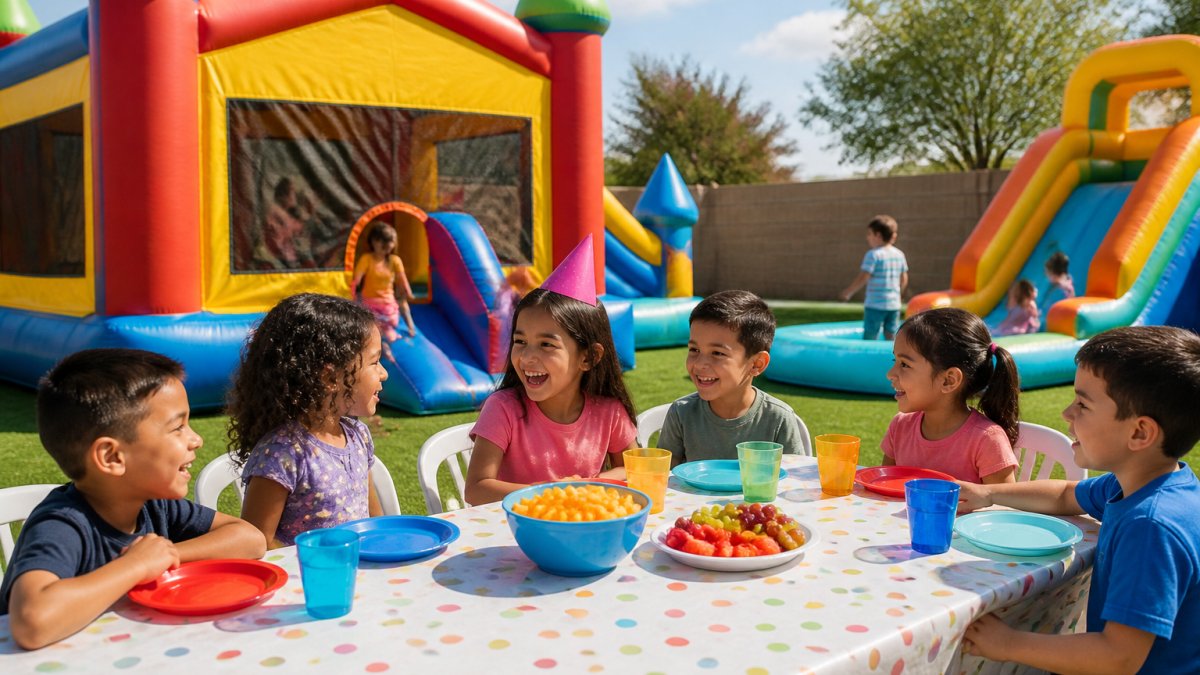
The single most effective way to keep kids entertained at a birthday party is to plan games and activities, not decorations. Research from Chuck E. Cheese's birthday party study found that only 23% of parents said themes or decorations help, while children consistently ask for more games and activities.
A backyard with a few strong activities runs smoother than a perfectly themed room with nothing to do. Kids do not care about the balloon arch. They care about what they get to do next.
Below, we break down how to keep kids entertained at a birthday party with games, crafts, and a schedule that holds up. You will get age-specific ideas, a sample timeline, and budget options that actually work.
Indoor Birthday Party Games for Kids That Work in Small Spaces
Small spaces call for games that burn energy without needing a yard. These indoor birthday party games for kids work in living rooms, garages, and community rooms:
- Balloon volleyball. Tape a line down the middle, hit a balloon back and forth, and you have a game. No net needed.
- Musical statues. Play music, stop it, and everyone freezes. Simple, fast, and funny.
- Freeze dance. Same idea, but kids dance until the music stops. Great for toddlers.
- Simon says. A classic that needs zero setup and keeps a group focused.
- Indoor obstacle course. Pillows, cushions, and painter's tape on the floor make a course in minutes.
- Hot potato. Pass a ball or stuffed animal until the music stops.
A common mistake is planning games that need a lot of room. Pick two or three that fit your space and rotate them. Kids lose interest in a single game after about ten minutes.
Birthday Party Crafts for Kids: Low-Mess Stations That Keep Hands Busy
Crafts work best as stations, not a single group activity. Set up two or three birthday party crafts for kids at separate tables so children move between them at their own pace.
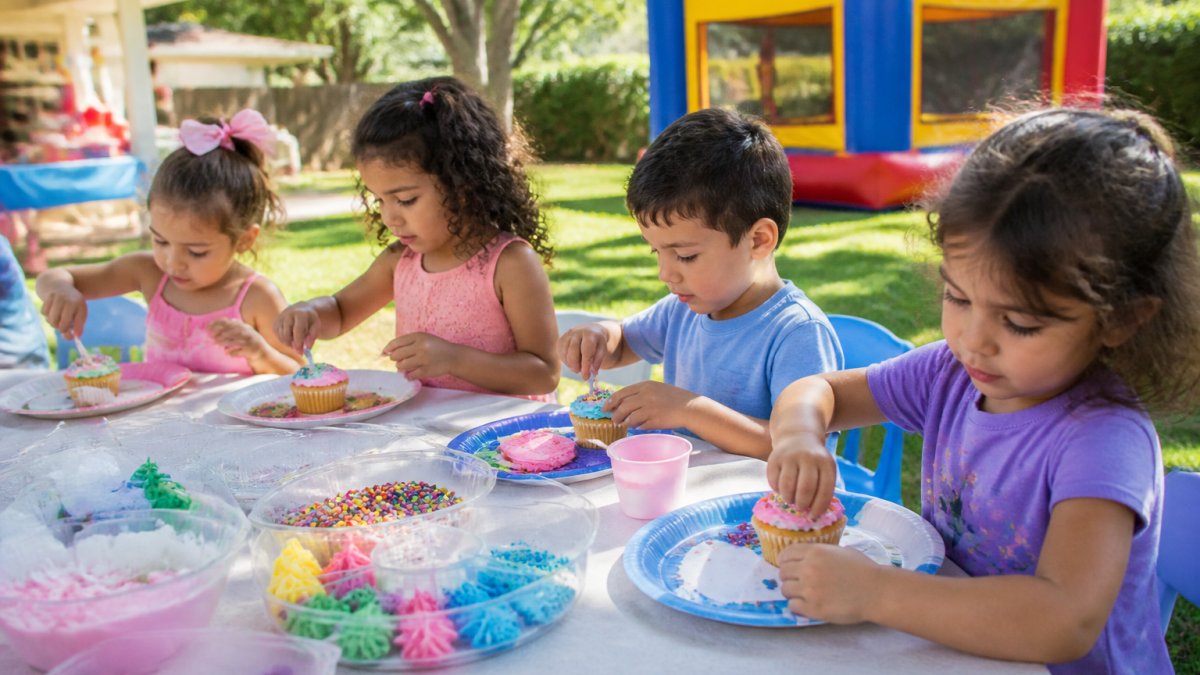
Low-mess options that hold attention:
- Cupcake decorating. Pre-bake plain cupcakes and let kids add frosting and sprinkles. This doubles as a treat.
- Playdough stations. A ball of playdough and a few cookie cutters keep little hands busy for a long time.
- Sticker and coloring tables. Cheap, quiet, and good for shy guests who need a break from the group.
Skip glitter and paint unless you have outdoor space and older kids. They add cleanup time and stress.
Birthday Party Activities for Different Ages, Group Sizes, and Abilities
Age changes everything. A game that delights a 6-year-old will bore a 10-year-old and overwhelm a toddler. But age is only one variable. The guest list also has a size, a mix of temperaments, and often a child or two with sensory, mobility, or attention differences. Most party guides stop at age bands. This section goes further so the plan actually fits the room.
Age bands and what actually lands
Toddlers (ages 2-3). Attention spans run about five to ten minutes per activity. Plan short, repeatable loops rather than one long game. Bubbles, a playdough table, a small ball pit or inflatable, and freeze dance all work. Skip anything with winners and losers, toddlers do not process competition and it usually ends in tears. Have a quiet corner with books or a sensory bin for the child who needs to step away.
Young kids (ages 4-8). This is the sweet spot for structured games. Relay races, treasure hunts, piñatas, parachute games, and bounce houses all land well.
Older kids and tweens (ages 9-12). They want challenge and independence.
Teens (ages 13+). Structured party games often read as childish. Lean toward food stations, music, a movie or gaming setup, and one optional group activity they can opt into.
Group size: how many kids change the plan
- Under 8 guests. One activity at a time runs fine. You can be the game leader and keep everyone in a single group.
- 8 to 15 guests. Split into two teams and rotate between two stations. One adult per station is enough for most games.
- 15 or more guests. Stations are non-negotiable. Run three or four activity stations with a two-minute warning before each rotation, and assign one adult or older sibling per station. A single group game with 20 kids usually collapses into chaos within minutes.
A useful rule of thumb: one supervising adult per six to eight children for active games, and one per ten for seated crafts.
Adaptations for abilities, sensory needs, and shy guests
Inclusive planning is not extra work, it is the same activities with a second way to play.
- Mobility differences. Offer seated versions of active games: balloon volleyball from a chair, seated freeze dance with arm movements, or a craft station as an equal alternative to relays. Keep pathways between stations wide enough for a wheelchair or walker.
- Sensory sensitivity. Loud music, sudden noises, and messy textures can overwhelm some kids. Set up a quiet room or corner with dim lighting and a few calm activities, and keep the volume moderate. Offer gloves for slime or sensory bins, and never force a child to touch a texture.
- Shy or opting-out guests. A craft table or coloring station gives a child a place to reset without feeling left out. Never single out a child who does not want to play, announce activities as optional and let them join when ready.
Keep one backup game ready in case an activity falls flat. A five-minute filler like Simon Says or hot potato buys you time to reset the next station.
Watch Out: Do not plan every minute. A buffer of ten to fifteen minutes across the party absorbs the inevitable delays, a late guest, a spill, a meltdown, without throwing off the schedule.
A Birthday Party Schedule for Kids That Prevents Boredom and Meltdowns
A solid birthday party schedule for kids alternates active and quiet activities.
Here is a sample flow for a two-hour party:
| Time | Activity | Why It Works |
|---|---|---|
| First 20 min | Free play and arrival | Guests trickle in; no one waits |
| Next 20 min | Active game or inflatable | Burns energy early |
| 20 min | Craft or food station | Calm reset |
| 20 min | Group game or relay races | Rebuilds excitement |
| 15 min | Cake and treats | Natural slowdown |
| 15 min | Piñata or final activity | Big finish |
| Last 10 min | Cool-down and pickup | Ends calm |
The key is transitions. Give a two-minute warning before switching activities. Kids handle change better when they see it coming.
Watch out: front-loading all the active games leaves kids worn out before cake, and back-loading them leads to chaos at pickup.
If you are adding an inflatable to the schedule, check our bounce house safety checklist so the timing and supervision line up.
Budget-Friendly and Free Activities That Still Keep Kids Entertained
You do not need a big budget to keep kids entertained. Plenty of free activities hold attention just as well as paid entertainment, the difference is in how you set them up. This section labels ideas by what they actually cost so you can build a plan around your budget instead of guessing.
Genuinely free (household materials only)
- Treasure hunts and scavenger hunts. Write clues on index cards or printer paper and hide small prizes or treats. The only cost is paper and a pen you already own. A picture-based hunt works for kids who cannot read yet.
- Relay races and field games. Sack races with pillowcases, egg-and-spoon with plastic eggs, and three-legged races with bandanas need nothing you have to buy.
- Simon Says, freeze dance, musical statues, and hot potato. A phone and a speaker are the entire setup. These are the highest-value free games because they scale to any group size.
Low-cost (a few dollars in supplies)
- Cupcake decorating. Pre-bake plain cupcakes and set out frosting and sprinkles. This doubles as the treat and replaces a separate dessert line item.
- Playdough or sensory bins. A few tubs of playdough and cookie cutters, or a bin of rice and scoops, keep little hands busy for a long stretch. Put a washable tablecloth or a shower curtain underneath.
- Sticker and coloring tables. Cheap, quiet, and good for shy guests who need a break from the group.
Where budget actually helps
Spending money does not make a party better across the board, it makes one thing better: the anchor activity.
A useful split is to put most of the budget into one anchor and keep games, crafts, and food simple. For a concession-style treat without the planning, a popcorn maker rental keeps kids happily busy and doubles as a snack station.
The cheapest parties that work are not the ones with the most activities, they are the ones with one reliable anchor and two or three free games that fit the space. Spend on the anchor, keep the rest cheap.
What to skip to protect the budget
- Glitter and paint unless you have outdoor space and older kids. They add cleanup time and stress.
- Single-use themed supplies that only fit one party. Reusable tablecloths, serving trays, and game props pay off across multiple birthdays.
- Too many paid add-ons. Two small paid extras rarely beat one strong anchor.
Plan Your Party Setup with Lil Bubs Bounce House
The fastest way to keep kids entertained is to give them one big thing to do. That is where we come in.
Lil Bubs Bounce House rents safe, clean inflatables for birthdays in the Avondale area. If you have questions before reserving, our frequently asked questions cover booking and logistics.
Want to see what is available? Browse our party rentals and bounce house options or check the kids' birthday party rentals guide for help choosing the right size.
Here is the honest part: a great party comes down to having enough to do. Games, crafts, and a schedule do the heavy lifting.
Frequently Asked Questions
How many activities should you plan for a kids' birthday party?
Plan three to five activities for a two-hour party, plus free play. A workable flow is one active game to burn energy, one craft or play station, a food and cake break, and a calm wind-down. Each activity should run 15 to 25 minutes, and always have one backup game ready in case something falls flat or the group moves faster than expected.
How do you keep kids entertained at a birthday party when they get bored?
Boredom usually means the activity is too slow or too hard for the group. Switch to a high-participation game like a treasure hunt, relay race, or freeze dance, which need no setup and pull in every child. Keep a short backup list taped inside a cabinet, and rotate stations every 15 minutes so kids who opt out of one activity have something new to join.
How do you entertain children of different ages at one party?
Split activities by ability rather than age. Toddlers do well with sensory play, playdough, and simple songs; ages 4 to 8 handle relay races, crafts, and treasure hunts; older kids and teens prefer team challenges, music, and performance games. Run two versions of the same game at different difficulty levels so everyone participates together without anyone feeling babied or overwhelmed.
What are good indoor birthday party games for kids in a small space?
Choose games that move little but engage a lot: freeze dance, musical chairs, balloon volleyball on knees, charades, and a living-room treasure hunt with picture clues. Crafts and play stations with slime or playdough also work well indoors because they keep hands busy without running. Clear breakables first, set boundary tape on the floor, and keep groups to six or eight kids per station.
Ready to take the stress out of party planning? Get started with Lil Bubs Bounce House and reserve a clean, safe inflatable with delivery and setup handled for you.